The curious flock keeper’s guide
Black Soldier Fly Larvae
Small insect. Big nutrition. A thoughtful way to bring protein, energy, and natural pecking pleasure to your flock, alongside the complete feed that stays at the center of the diet.
In this guide
What are black soldier fly larvae?
Black soldier fly larvae, often called BSFL, are the young form of Hermetia illucens. They are insects, not earthworms—and they are different from the larvae of a mealworm beetle.
The larval stage is a time of intense growth. Larvae turn what they eat into their own body tissue, storing the protein and fat that make them interesting as animal feed. [1]
For your chickens, dried larvae offer a familiar idea in a convenient form: insects to peck, with nutrients to contribute.
The life cycle, stage by stage
One insect, five stages. Choose a stage to read about it. Timing varies with temperature, feed, and growing conditions. [1]
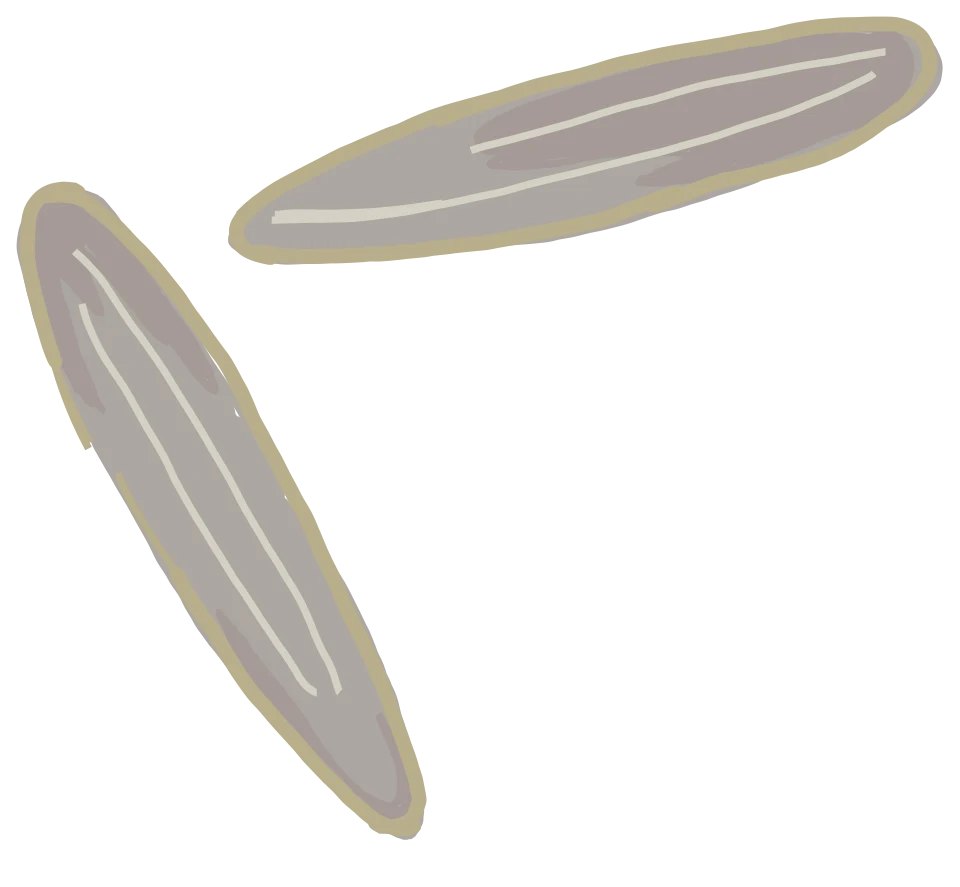
Egg · About 4 days to hatch
A very small beginning.
A female lays a cluster of eggs in sheltered crevices near a food source. Tiny larvae emerge after hatching.
The cycle begins here.
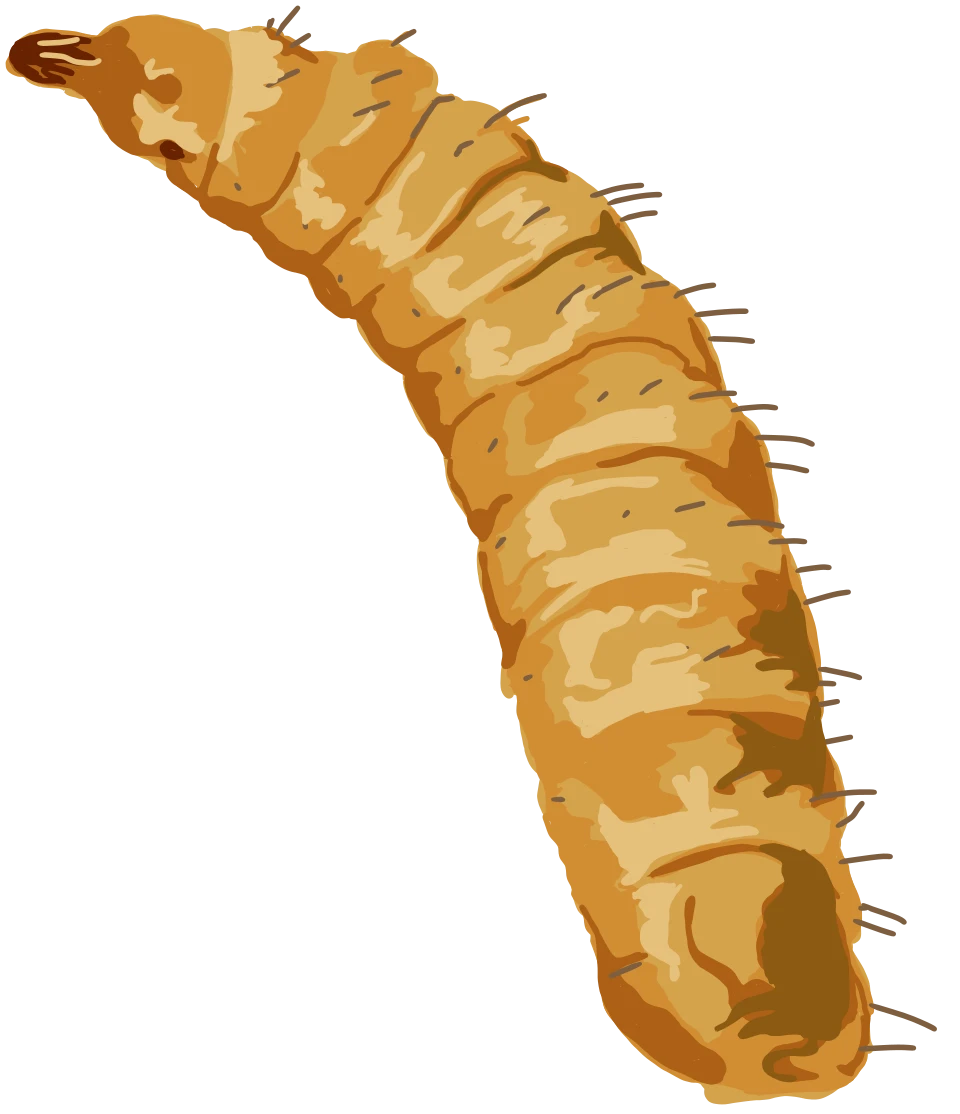
Larva · Often about 2 weeks of growth
The stage your chickens love.
Larvae eat, grow, and store nutrients as they pass through several growth stages. This is the stage harvested for insect feed.
This is the nutrient-building stage.
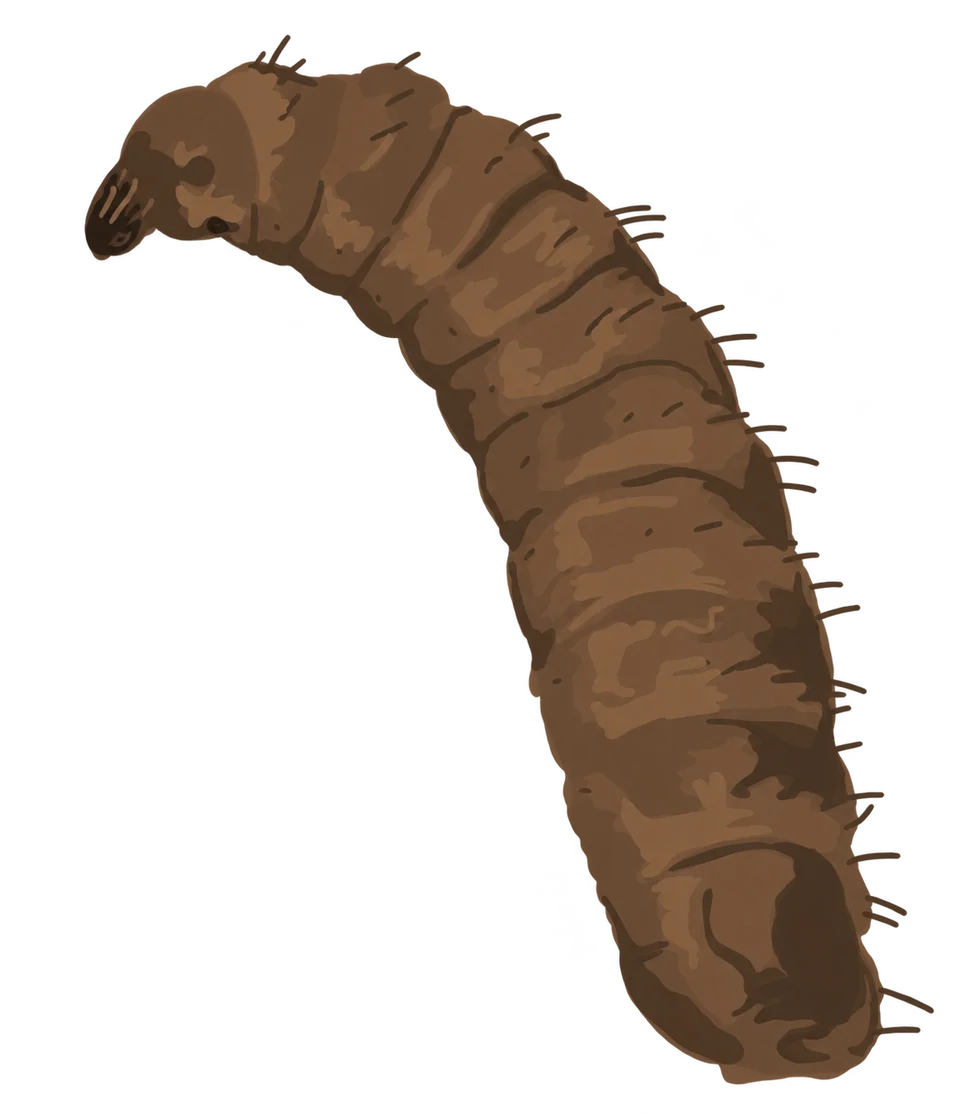
Prepupa · The transition to pupation
Ready for a transformation.
Mature larvae darken, stop feeding, and move toward a dry, sheltered place. The prepupa is the final larval stage, not a different species.
A darker color can be a normal life-stage change.
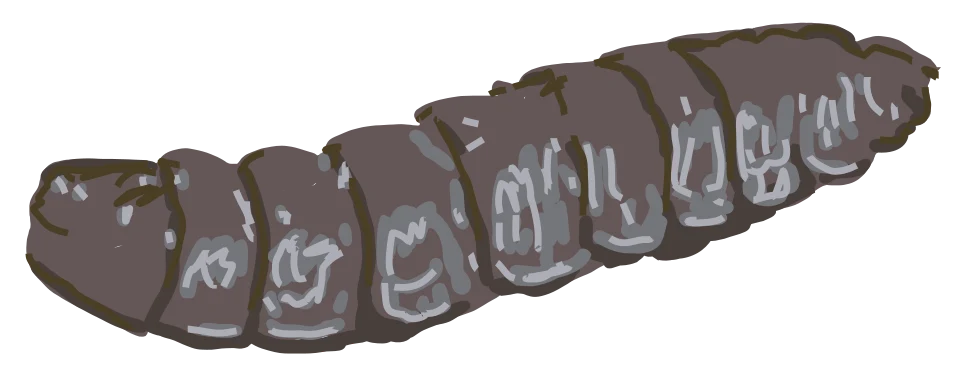
Pupa · About 2 weeks
A quiet transformation.
The pupa develops inside the hardened skin of the final larval stage, called the puparium. Inside that protective case, it transforms into an adult fly.
The outside can look similar to a prepupa. The pupa is developing inside the case.
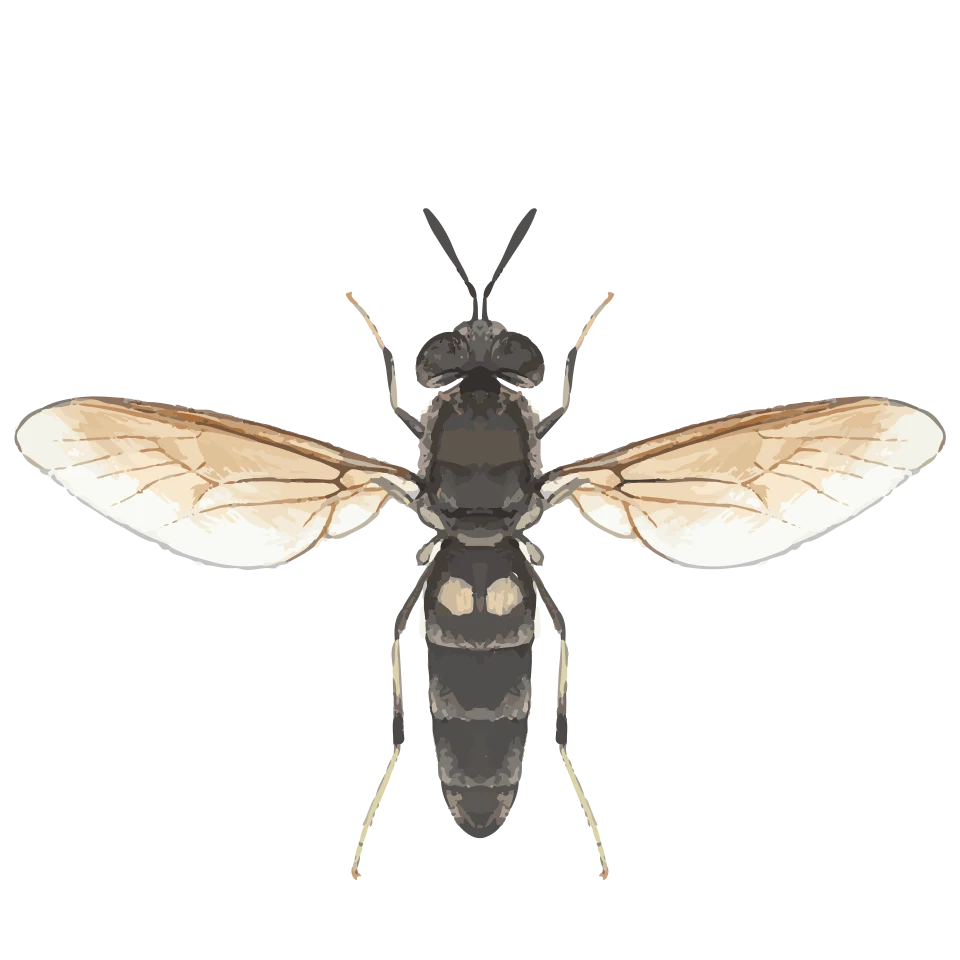
Adult · The cycle starts again
A fly with a different job.
Adults mate and females lay eggs, beginning a new generation. They are generally not considered household pests.
The adult is a fly. The feed ingredient is the larva.
What larvae add to a flock’s diet
Protein and fat are only part of the story. The whole diet—and the way you offer larvae—matters.
Protein for the job.
Protein supplies amino acids used to build and maintain tissues. BSFL contribute protein to a flock’s diet; they work alongside the complete ration. [2]
Calcium counts.
BSFL generally contain much more calcium than mealworms. That is useful for hens, whose complete layer ration must support eggshell formation. Larvae alone do not meet every calcium need. [2, 6]
Energy, naturally.
Whole larvae contain fat, including lauric acid. That makes them an energy-rich addition—and a reason to feed them thoughtfully. [2]
A reason to peck.
Scattered dried larvae encouraged foraging in a commercial laying-hen study. Offer small portions in a clean, dry area to give your flock something to explore. [3]
Inside Tucker’s larvae
Our published guaranteed analysis. Check the current package for feeding directions.
- Crude protein minimum
- 40%
- Crude fat minimum
- 30%
- Calcium range
- 1.75–2.25%
- Lauric acid minimum
- 12%
These figures describe Tucker’s product; they are not averages for all BSFL. See the full product analysis.
Why choose larvae over mealworms?
Mealworms offer protein and fat, but very little calcium relative to phosphorus. That imbalance matters when treats push balanced feed out of a laying hen’s diet.
| What matters | Black soldier fly larvae | Mealworms |
|---|---|---|
| The insect | Young black soldier flies | Young darkling beetles |
| Calcium | The standout advantage. Typically much higher. | Very low relative to phosphorus. Can dilute calcium when replacing layer feed. |
| Protein & energy | A useful source of both. | A useful source of both; protein can be higher. |
| For the whole diet | Complement an appropriate complete feed. | Complement an appropriate complete feed. |
| What to compare | Current labels, growing feed, processing, and supplier transparency—not just a front-of-bag protein number. | |
Why reptile owners dust their insects
The review’s mealworm example contains about 17.5 times as much phosphorus as calcium. That is why mealworms cannot be treated as a balanced mineral source. [2] Veterinary reptile guidance recommends phosphorus-free calcium dusting; calcium carbonate is also the calcium source in limestone. The powder compensates for a mineral shortfall in the insect. [9]
That illustrates the problem—it is not a recipe for dusting your chickens’ treats or applying a reptile’s target ratio to a laying hen.
A hen has to build a shell
When dietary calcium is inadequate, shell quality can suffer. Continued withdrawal of calcium from bone can weaken the skeleton and contribute to osteoporosis. A protein-rich treat does not supply the missing calcium simply because it is nutritious in other ways. [10]
See what a treat changes
A protein treat can dilute calcium.
If mealworms replace part of a balanced layer feed, the whole diet changes. This example starts with a feed containing 4.00% calcium and 0.60% total phosphorus, and mealworms containing 0.04% calcium and 0.70% phosphorus. [2]
4.0%3.6%
9.9% less calcium at the same dry food intake6.7:15.9:1
Total phosphorus: 0.610%This example models mealworms only. Tucker’s larvae label guarantees calcium and available phosphorus, not the total phosphorus this calculation uses. See the larvae’s guaranteed analysis
At 10% replacement, each 100 g of dry food supplies 3.6 g of calcium instead of 4.0 g—396 mg less. The calcium contribution drops by almost one-tenth.
The assumptions behind the numbers
Exact figures at this setting: 3.604% calcium (from 4.000%), total Ca:P 5.91:1 (from 6.67:1), total phosphorus 0.610%. The figures above are rounded to one decimal.
The layer feed is an illustrative starting diet, not a Show Flock analysis or a feeding target. Mealworm values come from the review’s dry-matter table; retail products vary. All inputs and the replacement percentage use dry weight, so water content does not distort the comparison. Ten percent by volume or calories is a different calculation. This assumes mealworms displace feed at unchanged total dry food intake.
Calcium = (feed share × 4.00) + (mealworm share × 0.04). Phosphorus = (feed share × 0.60) + (mealworm share × 0.70). Divide calcium by phosphorus to get total Ca:P. This is total phosphorus, not available phosphorus; the ratio alone cannot establish nutritional adequacy. The slider illustrates dilution, not a recommended treat allowance.
Your older hen still needs strong bones
4.1 g4.5 g
Backyard hens can stay with a family for years. An older hen still laying large eggs may face a tougher calcium task: larger eggs, declining calcium absorption, and a skeleton exposed to repeated laying cycles. Protecting her mineral intake matters long after her first season. [12]
Lohmann breeder guidance describes daily calcium needs increasing from about 4.1 g at peak production to 4.5 g with age. A roughly 10% dilution moves intake in the opposite direction. Those commercial figures illustrate the principle; actual needs depend on laying activity, intake, breed, and health. [11]
Keep complete layer feed central. Discuss suitable coarse calcium, such as oyster shell or feed-grade limestone, with your flock’s feeding adviser. It can supply calcium through shell formation, including overnight. More powder is not automatically a better feeding program. [10]
The source matters. So does the feed.
Larvae can accumulate contaminants from their growing feed. Knowing the producer and its inputs is a meaningful part of choosing quality. [5]
The Tucker difference
Raised here. Fed with intention.
- Northeast Alabama raised.Our own facility, with a producer you can contact.
- A Show Flock-quality growing diet.Our company nutritionist formulated this diet specifically for black soldier fly larvae, with the goal of making them as nutritious as possible. We do not raise our larvae on human waste, pig manure, or rotting food waste.
- Published nutrient guarantees.Compare the analysis and ask us questions about how our larvae are grown.
What one retail study found
A reason to look beyond the price.
Table 1 sample averages: 13 China-sourced products and 4 North American products. Both charts use the same scale. Origin came from labels; the authors work for Perdue, a larvae seller. The lead and arsenic differences in Table 1 were not statistically significant (p > 0.05), and the reported total sample counts disagree. This was a small retail study—not a test of Tucker’s larvae or every imported product. Averages cannot establish an individual product’s safety.
In a 2025 study, China-sourced samples had about 25× the average lead and 8× the average arsenic of North American samples. [4]
Melamine made supplier accountability real
In 2007, FDA investigated pet deaths linked to melamine-contaminated food; wheat gluten and rice protein imported from China were implicated. In 2008, WHO documented melamine-contaminated infant formula in China. These were serious failures of ingredient integrity. [13, 14]
They explain why traceability and testing deserve attention. They do not establish that today’s Chinese-grown larvae contain melamine.
Waste can grow larvae. Our diet is purpose-built.
Published Chinese research has raised BSFL on pig manure. Other waste-treatment research has used human feces. Those are documented growing substrates, not assumptions about a particular retail bag. [15, 16]
Larvae can reduce some pathogens in waste, but reductions vary and do not establish that every resulting feed product is safe. Ask for the actual growing inputs and testing. Tucker’s larvae receive our nutritionist’s specially formulated Show Flock-quality diet.
How to feed larvae
A little goes a delicious way. Use larvae to enrich your flock’s day. Keep complete feed at the center of the diet.
Start with the right feed.
Choose complete feed for your birds’ age and purpose. Chicks, growing meat birds, and laying hens have different needs. [6]
Offer a modest portion.
Keep the current package directions in view. Nutrient-rich larvae still add calories and can change the balance of the overall diet.
Keep it clean and dry.
Offer in a clean area, protect stored larvae from moisture and pests, and provide fresh drinking water. [6]
Make it fit your flock.
For chicks, a mixed-age flock, or a specific nutrition goal, ask our nutritionist how larvae fit your feeding program.
Ask our nutritionist
Questions flock keepers ask
Will dried larvae turn into flies?
No. Properly dried, nonliving larvae cannot continue their life cycle. The adult fly in the illustrations explains the biology, not what will happen inside a bag.
Can they replace complete chicken feed?
No. A useful ingredient is not the same as a complete ration. Whole larvae should complement feed suited to the bird’s age and purpose. [6]
Do hens still need calcium?
Yes. Hens need a diet that meets their calcium needs. BSFL contribute much more calcium than ordinary mealworms, but their calcium level is still below many complete layer feeds. They do not automatically replace layer feed or a calcium supplement your feeding program calls for. [6]
Will they improve immunity or increase egg production?
Researchers are studying insect ingredients and bird health, but outcomes depend on the product, inclusion rate, and the rest of the ration. We do not promise disease prevention, a guaranteed egg increase, or a universal growth advantage. [8]
Are all black soldier fly larvae the same?
No. Growing feed, harvest stage, and processing affect their composition. Compare actual labels and ask the supplier about its production practices. [2]
Are they a sustainable choice?
BSFL can turn suitable organic materials into a useful feed ingredient. The environmental footprint still depends on growing inputs, energy, drying, and transport. We do not publish a Tucker-specific footprint without a measured life-cycle assessment.
Sources
Research explains the insect. Our product label describes Tucker’s larvae. The two are different kinds of evidence.
-
Black Soldier Fly: Description and Life Cycle ↩
Species identification, development, and life-stage timing. Conditions can change how quickly insects develop.
-
Insects as an alternative protein source for poultry nutrition: a review ↩
Table 1 reports insect-meal composition on a dry-matter basis. Literature values are not guarantees for a particular retail bag.
-
Dried black soldier fly larvae as environmental enrichment for laying hens — a full-scale commercial study ↩
Scattering dried larvae increased foraging in the studied commercial flocks. How larvae are offered matters.
-
High levels of lead and arsenic in imported dried black soldier fly larvae: implications for backyard poultry supplementation ↩
Origin came from labels. Authors work for Perdue, a larvae seller. Table 1 lead/arsenic p-values exceed 0.05 despite stronger abstract wording. Reported total sample counts disagree. Averages cannot establish an individual product’s safety.
-
Safety of black soldier fly larvae reared on waste streams of animal and vegetal origin and manure ↩
Examines substrate-related contaminants and processing controls. Cadmium accumulated in larvae across tested substrates.
-
Complete rations, age-specific nutrition, calcium for layers, and dry storage.
-
Chicken Treats: Are They Good for My Laying Hens? ↩
The 90/10 guideline for complete layer feed and total treats. General flock guidance, not a Tucker product feeding trial.
-
A Systematic Review and Metanalysis on the Use of Hermetia illucens and Tenebrio molitor in Diets for Poultry ↩
Both insects can be useful. Mealworm meal produced greater average daily gain than BSFL meal in this analysis; BSFL do not win every performance comparison.
-
Care and Housing for Chameleons ↩
Veterinary guidance on phosphorus-free calcium dusting of feeder insects. Reptile requirements and supplementation schedules are not chicken feeding instructions.
-
Mineral Deficiencies in Poultry ↩
Calcium deficiency, shell quality, bone depletion, and the value of appropriately sized coarse calcium particles.
-
Management of Laying Hens under Tropical Conditions Begins During the Rearing Period ↩
Reports calcium intake guidance rising from about 4.1 to 4.5 g per hen daily with age. Commercial-breeder guidance illustrates changing needs; it is not a universal dose for every backyard hen.
-
Relationship between Bone Quality, Egg Production and Eggshell Quality at 105 Weeks ↩
Extended-cycle laying hens, eggshell quality, and bone health. Older birds may have reduced calcium absorption and larger eggs. A treat-dilution calculation does not predict disease in a particular hen.
-
Protein Surveillance Assignment Summary Report ↩
Documents melamine-related contamination involving wheat gluten and rice protein imported from China. This was not a BSFL investigation.
-
Melamine-contaminated powdered infant formula in China ↩
Documents the infant-formula contamination incident. Historical context for supplier accountability, not evidence about a present-day larvae batch.
-
Inhibition of Zoonotic Pathogens Naturally Found in Pig Manure by BSFL ↩
Chinese research used pig manure as a larval substrate. Waste-treatment research does not establish what an unspecified retail supplier feeds its larvae.
-
Faecal sludge management with black soldier fly larvae—from a hygiene aspect ↩
Researchers examined larvae in human feces. Pathogen reduction differed among organisms; waste treatment is not proof of feed-product safety.
Illustration credits
Original biological artwork by the DataBase Center for Life Science (DBCLS), via Wikimedia Commons, licensed under CC BY 4.0. Resized and converted for web use. The prepupa adapts the larva illustration, with a brown palette and a subtly revised pose made using AI; color and pose are illustrative. The pupa is shown inside an elongated puparium, using the external-case artwork originally labeled prepupa. Illustrations are not photographs of Tucker’s product.